A capillary underfill is a liquid epoxy dispensed along the edge of a flip chip or BGA after mounting, which flows into the gap under the die. Once cured, it shares the stress that the chip-substrate expansion mismatch puts on the solder joints, extending package life.
Engineers choosing a BGA underfill material usually hit two questions first: does it fill under the die fast enough, and does it leave voids behind? Both come down to the underfill's viscosity and thixotropic index (TI).

What underfill does
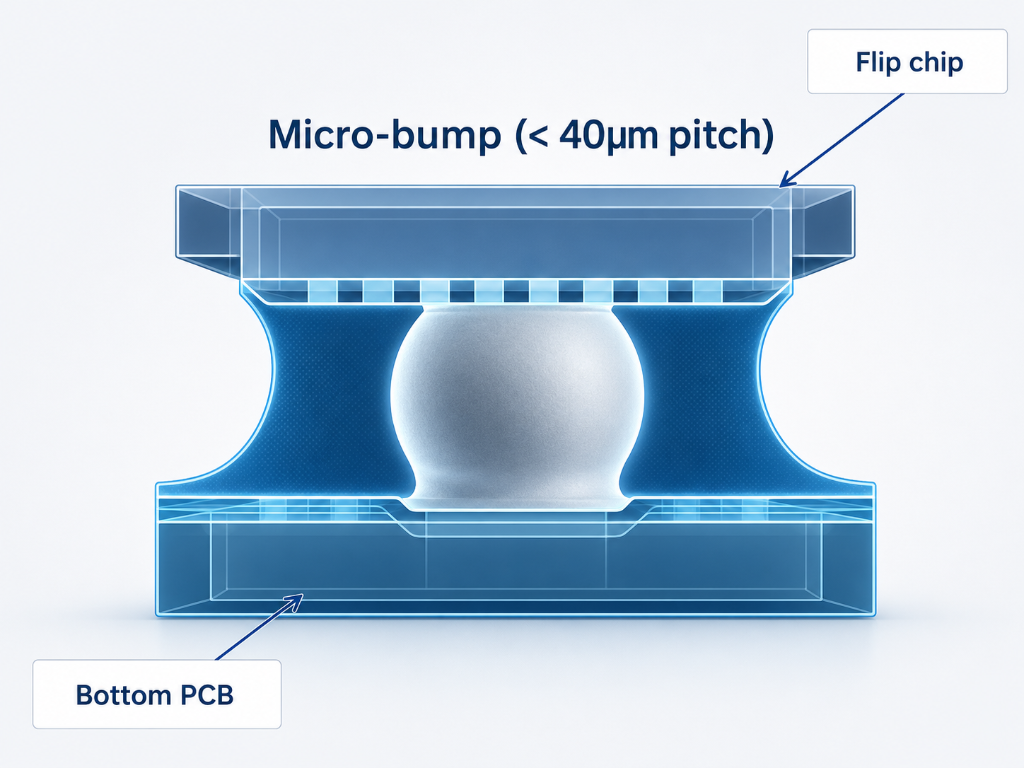
Silicon and organic substrates expand very differently with temperature. Without underfill, that mismatch lands directly on the solder bumps and cracks the joints over repeated thermal cycles. Underfill locks the die and substrate together and spreads the stress across all the bumps and the resin. In devices that get dropped, such as smartphones, it also reinforces the joints against shock.
Viscosity sets the flow time
The time a capillary underfill takes to flow under a die roughly follows this relationship:
fill time ∝ viscosity × (flow distance)² ÷ (gap × surface tension × cosθ)
θ is the contact angle at which the underfill wets the die and substrate. In practice:
- Larger dies add time with the square of the flow distance. Doubling the die edge length roughly quadruples the fill time.
- Smaller gaps add time. Packages with finer bump pitch and lower bump height are at a disadvantage.
- Lower viscosity cuts time proportionally. That is why low-viscosity grades are evaluated first for large dies and tight gaps, and why substrates are often preheated to lower viscosity further during dispense.
TI decides whether it flows or holds its shape
The thixotropic index is the ratio of viscosity at a low shear rate to viscosity at a high shear rate. Two underfills with the same viscosity can behave differently depending on TI.
- TI close to 1: flows freely without being pushed. It wicks under the die quickly, but also spreads outward, so check clearance to nearby components.
- Higher TI: holds its shape where it is dispensed. Useful for consistent fillets or where underfill must not bleed.
Why voids form and how to reduce them
- Flow fronts closing around bumps: dense bump arrays or uneven flow speed trap air. Change the dispense pattern (I, L or U) and sequence so the flow front moves in one direction.
- Moisture and flux residue: moisture absorbed by the substrate and leftover flux outgas during cure. Check substrate pre-bake and flux cleaning together.
- Filler: filler particle size and shape directly affect flow and voiding in narrow gaps. See COFA's filler particle research white paper.
COFA 4000 series at a glance
COFA's flip-chip underfills come in three grades with different viscosity and TI. All are heat-cure epoxies with a cured hardness of Shore D 95.
| Grade | Viscosity | TI | Character |
|---|---|---|---|
| COFA 4100F | 11,000 cps | 1.0 | Low viscosity, fast fill |
| COFA 4200F | 45,000 cps | 1.7 | High viscosity, holds shape |
| COFA 4300F | 17,000 cps | 1.8 | Medium viscosity, stable fillet |
COFA 4100F
4100F is the lowest-viscosity grade in the 4000 series: 11,000 cps with a TI of 1.0, so it flows freely without being pushed. It is the first grade to evaluate for BGA, CSP and PoP packages where fill time is the constraint because the die is large or the gap is tight.
| Property | Value |
|---|---|
| Viscosity | 11,000 cps |
| TI | 1.0 |
| Cure | 120°C / 60 min |
| Hardness | Shore D 95 |
| Use | Capillary underfill for BGA, CSP and PoP flip chips |
Detailed properties are in the 4100FU technical data sheet (Korean).
Frequently asked questions
What is a capillary underfill?
A liquid epoxy dispensed along the edge of a flip chip or BGA after it is mounted. Capillary action draws it into the gap under the die. Once cured, it shares the thermal-expansion stress on the solder joints and improves thermal cycling and drop reliability.
How does underfill viscosity affect flow time?
Capillary fill time is proportional to viscosity and to the square of the flow distance. For the same die, a lower-viscosity underfill fills faster, and low-viscosity grades become more important as dies get larger and gaps get smaller.
What does the thixotropic index (TI) mean?
It is the ratio of viscosity measured at a low shear rate to viscosity at a high shear rate. A TI close to 1 means the material flows freely without being pushed, so it fills narrow gaps quickly. A higher TI holds its dispensed shape, which helps fillet and dam formation.
What causes voids in underfill?
The most common causes are flow fronts closing around bumps and trapping air, and moisture absorbed in the substrate or flux residue outgassing during cure. Dispense pattern, substrate preheat and pre-bake, and flux cleaning all need to be tuned together.
What are the key specifications of COFA 4100F?
COFA 4100F is a low-viscosity capillary underfill at 11,000 cps with a TI of 1.0. It cures at 120°C for 60 minutes to a hardness of Shore D 95, and is used for BGA, CSP and PoP flip-chip packages.
Share your process conditions
Tell us your package type, bump pitch and gap, dispensing method and cure profile, and we will review the right grade and an evaluation plan with you.
Published 2026-11-03 · COFA Co., Ltd. technical team