A die attach adhesive fixes a chip (die) to a substrate or lead frame. In image sensor packages, keeping the sensor die flat matters most: if the die bows, focus is no longer even across the image.
Image sensors in smartphones and vehicle cameras keep getting larger as resolution rises. The bigger the die, the more a small bow from the attach process shows up in the image. That is why die attach for large sensor dies is chosen by looking at cure temperature and bond-line modulus together.
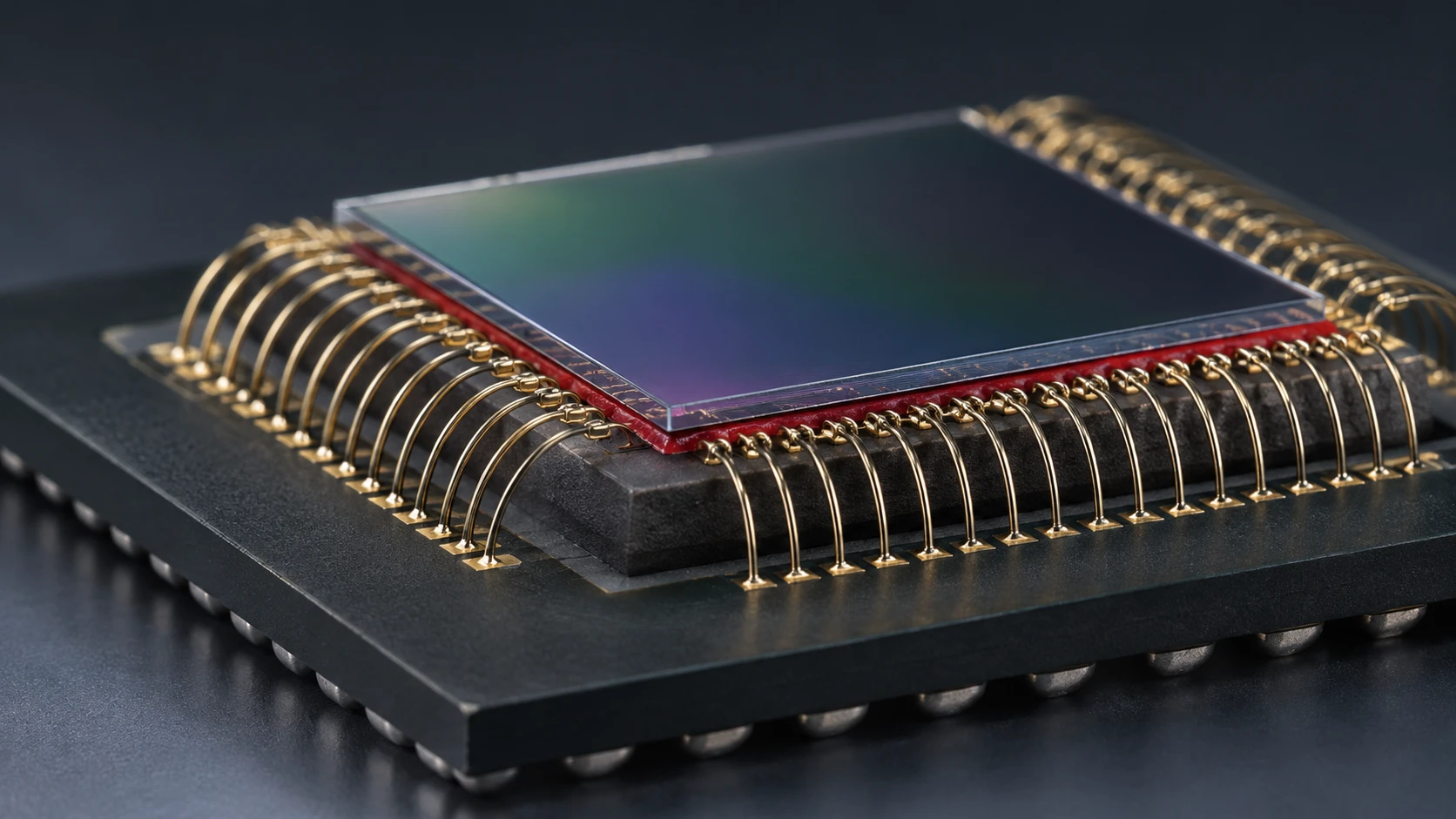
Why sensor dies bow
Silicon dies and organic substrates have very different thermal expansion. The adhesive sets at its cure temperature, and as the assembly cools to room temperature the substrate shrinks more than the die. That mismatch bends the die and substrate together into a smile (center down) or cry (center up) shape.
The remaining stress roughly follows:
residual stress ∝ bond-line modulus × CTE mismatch × (cure temperature − room temperature)
Die and substrate materials are usually fixed, so the two levers on the adhesive side are cure temperature and modulus.
Lowering the cure temperature
Compare an adhesive that cures at 150°C with one that cures at 80°C: the temperature drop to room temperature falls from about 125°C to about 55°C. For the same material stack, residual stress drops in proportion. A lower cure temperature also reduces the heat load on other parts already on the substrate.
Lowering the modulus
A low-modulus bond line acts as a buffer that absorbs deformation between die and substrate. When the die is large or the substrate thin and warpage is the issue, evaluate a lower-hardness grade first. The trade-off is that a softer bond line holds the die less firmly, so drop and vibration requirements need to be weighed too.
COFA 5000S series
COFA die attach comes in two grades with different hardness. Both are one-component red epoxies that cure in a convection oven at 80°C in 30 minutes. With no mixing step they go straight onto the dispenser, and they are stored at -20°C or below for 6 months.
| Grade | Viscosity | Hardness | Cure | Work life (25°C) | Focus |
|---|---|---|---|---|---|
| COFA 5001S | 23,000 cps | Shore D 70 | 80°C / 30 min | 48 h | Adhesion and impact |
| COFA 5002S | 21,000 cps | Shore D 35 | 80°C / 30 min | 48 h | Low modulus, smile-warpage control |
- 5001S: Shore D 70, focused on adhesion and impact performance, for places where the die needs to be held firmly.
- 5002S: Shore D 35, the low-modulus grade designed to control smile-shape warpage on large image sensor dies.
We also supply custom grades with viscosity and hardness tuned to your die size, substrate thickness and dispensing method.
Applications
- Large CMOS image sensor die attach in smartphone and vehicle camera modules
- Sensor module assembly alongside heat-sensitive parts
- Large-area die attach where warpage must be managed
Frequently asked questions
What is a die attach adhesive?
An adhesive that fixes a chip (die) to a substrate or lead frame. In image sensor packages it bonds the sensor die to the substrate, and the die has to sit flat so focus is even across the sensor.
Why is warpage a problem in image sensor packages?
If the sensor die bows, the focal distance differs between the center and the edges of the image. The larger the die, the larger the height difference at the edges for the same curvature, and the bigger the effect on image quality.
Why does low-temperature cure reduce warpage?
An adhesive sets at its cure temperature and then, as it cools to room temperature, takes stress from the expansion mismatch between die and substrate. That stress scales roughly with the gap between cure and room temperature, so a lower cure temperature leaves less stress and less bow.
When is a low-modulus die attach used?
When the die is large or the die-substrate expansion mismatch is big enough that warpage becomes an issue. A low-modulus bond line absorbs deformation and reduces the stress passed to the die. COFA 5002S is the low-hardness grade for this.
How do COFA 5001S and 5002S differ?
Both are one-component red epoxies that cure at 80°C in 30 minutes. 5001S, at Shore D 70, is for general die attach. 5002S, at Shore D 35, is the low-modulus grade for controlling warpage on large dies.
Share your process conditions
Tell us your package type, bump pitch and gap, dispensing method and cure profile, and we will review the right grade and an evaluation plan with you.
Published 2026-11-03 · COFA Co., Ltd. technical team