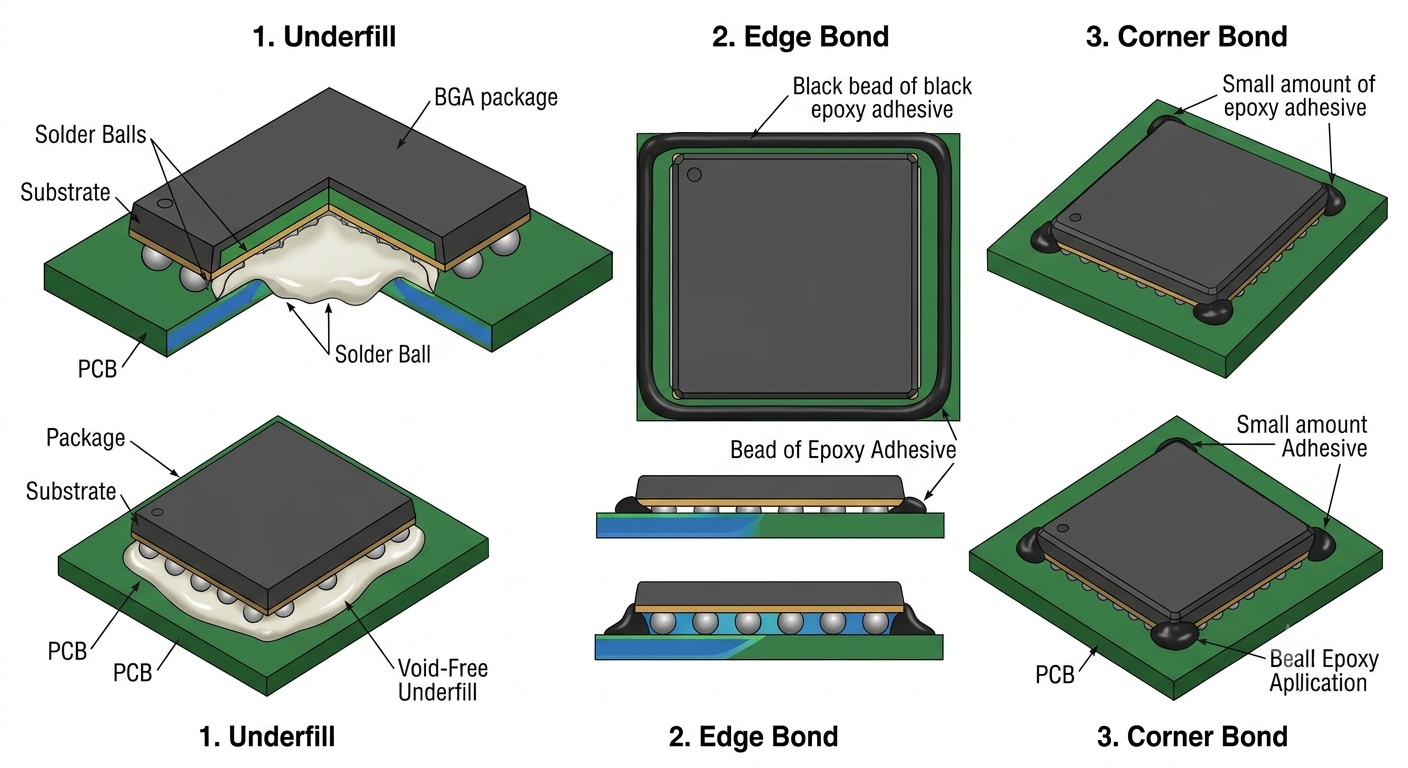
A board-level reinforcement adhesive ties BGA and CSP packages to the board to protect their solder joints. It is applied as a full board-level underfill, as an edge bond along the package edges, or as a corner bond at the four corners.
Main boards in smartphones and wearables get dropped, bent and thermally cycled, and BGA solder joints are usually the first to suffer. A reinforcement adhesive is there to protect those joints.
Why solder joints crack at the corners first
When a board bends or temperature changes, the package and the board move differently. The difference grows with distance from the package center, so the solder balls at the four corners take the highest stress. In drop and bend tests, cracks usually start at the corner joints. A reinforcement adhesive ties the package to the board so the stress no longer lands only on the solder balls.
Three reinforcement methods
| Method | Where it goes | Reinforcement | Process |
|---|---|---|---|
| Board-level underfill | Entire area under the package | Highest | Longer flow time, needs void control |
| Edge bond | Bead along the package edges | Medium | Fast to dispense, simple process |
| Corner bond | Four package corners | Focused on corners | Smallest dispense volume |
Use underfill when reliability requirements are high and there is time in the process. When throughput matters most, evaluate edge or corner bond first. Package size, clearance to nearby parts and board thickness also need to be considered.
Why low-temperature cure
Reinforcement is usually done after reflow, when every component is already on the board. By then the board carries heat-sensitive parts such as camera modules, plastic connectors and battery-related components. A high cure temperature can distort or damage them, so the cure temperature has to stay low.
A lower cure temperature also shortens oven time and saves energy. A one-component adhesive needs no mixing and goes straight onto the dispenser, and a longer work life means fewer material changes on the line.
COFA 3100H
3100H is the board-reinforcement epoxy in the COFA 3000H series. It is a black, one-component adhesive that cures at 80°C in 30 minutes, and the cure can be adjusted within 70–90°C to suit the board and component structure.
| Property | Value |
|---|---|
| Chemistry | Epoxy, one component |
| Color | Black |
| Cure | 80°C / 30 min (adjustable within 70–90°C) |
| Work life | 5 days or more at 25°C |
| Shear strength | 15 MPa or more (Si/Si) |
| Storage | -20°C or below, 6 months from manufacture |
Reliability test results
| Test | Condition | Result |
|---|---|---|
| Thermal cycling | -40°C to 125°C, 500 cycles | Pass (no die shift or crack) |
| Temperature-humidity | 85°C / 85% RH, 1000 h | Pass (adhesion retained) |
| High-temperature storage | 125°C, 500 h | Pass |
| Low-temperature storage | -40°C, 500 h | Pass |
Details are in the 3100H technical data sheet (Korean).
Engineering plastic housing attach
Beyond board reinforcement, 3100H is designed for bonding parts made of engineering plastics, such as camera module holders, sensor housings and connector housings.
- Low-temperature cure: plastic housings tolerate heat less well than metal or ceramic and distort easily at high cure temperatures. An 80°C, 30-minute cure reduces the heat load on the housing.
- Bonding dissimilar materials: plastic housings are often joined to PCB, metal or ceramic. 3100H uses a high-density ionic bonding structure to improve adhesion between dissimilar materials.
- Impact and moisture resistance: as a rubber-toughened epoxy it resists impact, and adhesion stayed within 0 to -15% of the initial value across substrates after 10 minutes of steam aging.
Applications
- Edge and corner bonding of BGA and CSP on smartphone and wearable main boards
- Bonding upper and lower packages in PoP (package on package)
- Fixing components on boards that also carry heat-sensitive parts
- Lens holder attach in camera modules and engineering plastic housing attach
- Bonding sensor chips and RF modules
Frequently asked questions
Why use a board-level reinforcement adhesive?
Solder joints of BGA and CSP packages mounted on a board are stressed by drops, bending and temperature changes. Stress concentrates at the package corners, so those joints fail first. A reinforcement adhesive ties the package to the board and shares that stress.
How do edge bond, corner bond and board-level underfill differ?
Board-level underfill fills the whole area under the package and gives the most reinforcement, but takes longer to flow and is harder to process. Edge bond runs a bead along the package edges, and corner bond applies adhesive only at the four corners, which keeps the process simple. The choice depends on required reliability and process margin.
Why use a low-temperature cure epoxy for board reinforcement?
Reinforcement is often done after every other component is already mounted. If heat-sensitive parts such as camera modules or plastic connectors are on the board, the cure temperature has to stay low. A lower cure temperature also shortens oven time and saves energy.
What is the cure schedule for COFA 3100H?
The standard cure is 80°C for 30 minutes, adjustable within 70–90°C depending on the board and component structure. It is a one-component adhesive with no mixing step and a work life of 5 days or more at 25°C.
Can COFA 3100H be used to bond plastic housings?
Yes. 3100H is designed for bonding engineering plastic parts such as camera module holders and sensor or connector housings. Its 80°C cure reduces housing distortion, and it is formulated for stronger adhesion between dissimilar materials. We run bond-strength evaluations on your actual housing material with you.
What reliability tests has COFA 3100H passed?
It passed -40 to 125°C thermal cycling for 500 cycles, 85°C/85% RH for 1000 hours, and 500-hour storage at both 125°C and -40°C.
Share your process conditions
Tell us your package type, bump pitch and gap, dispensing method and cure profile, and we will review the right grade and an evaluation plan with you.
Published 2026-11-03 · COFA Co., Ltd. technical team